
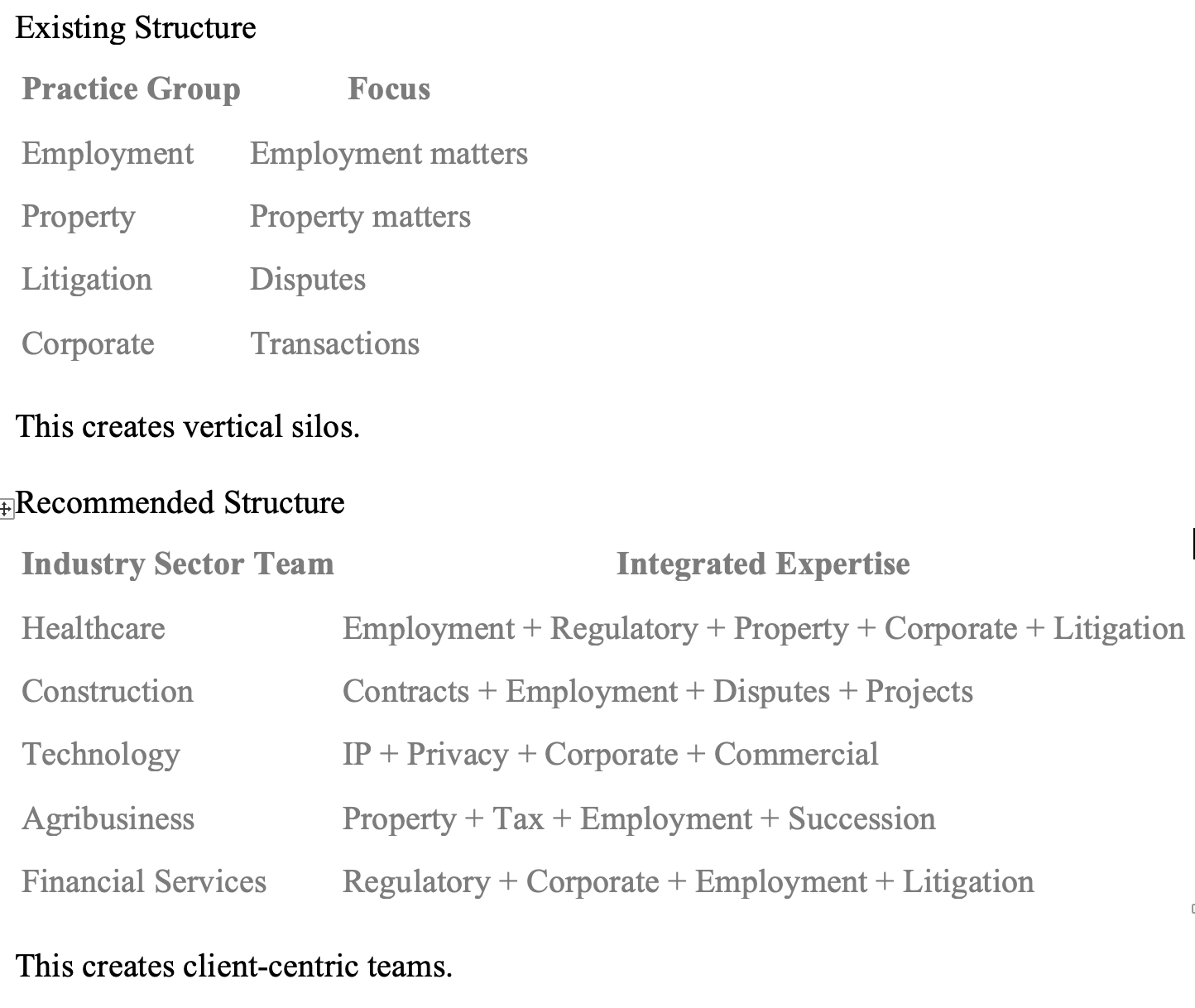
Most law firms are still structured around legal disciplines. Employment. Property. Tax. Litigation. Corporate. That structure made sense when clients purchased isolated legal services. Today they do not. Clients increasingly want advisers who understand their industry, anticipate risks, bring commercial insights and proactive ideas and help them grow and protect their business. The firms that organise around industries rather than technical silos are becoming significantly more valuable to clients and harder to replace.
The core problem with traditional Practice Group structures is that they unintentionally create internal silos, limited collaboration, partner territorialism and multiple disconnected client relationships leading to cross selling resistance.

A client in the construction industry does not wake up thinking: “I need employment law today.” They think:
• “We are struggling with workforce shortages.”
• “A regulator is increasing scrutiny.”
• “Margins are under pressure.”
• “AI and technology are changing delivery.”
• “We are acquiring another business.”
• “Industrial relations risks are growing.”
• “Supply chain issues are affecting projects.”
Those issues can touch Employment, Disputes, Contracts, Property, M&A, Regulatory, Tax, IP, Privacy and ESG. Clients experience problems commercially. Law firms are often structured technically. That mismatch creates opportunity for competitors.
Why Industry Sector Teams Win
1. Clients Buy Industry Understanding
An industry-focused firm speaks the client’s language. Instead of: “We provide employment advice.” The conversation becomes: “We help healthcare operators reduce workforce risk, navigate compliance changes and scale safely.” That positioning is more commercial, strategic, differentiated and ultimately more valuable.
2. Cross-Selling Happens Naturally
Practice groups force partners to “refer work.” Industry teams create shared client ownership. Instead of separate client relationships, isolated matters and internal competition, you create one sector plan, shared growth objectives and collaborative client servicing. The discussion changes from “Who owns the client?” to “How do we deepen the relationship?”
3. Clients Receive More Proactive Advice
Sector specialists see patterns earlier. For example: A hospitality sector team notices wage theft investigations increasing, licensing changes emerging, insurance claims trends rising, labour shortages worsening and AI booking technologies disrupting operators. That creates opportunities for alerts, roundtables, webinars, benchmarking reports, client briefings, board presentations using preventative advice. The firm becomes proactive rather than reactive.
4. It Creates Stronger Market Positioning
Most firms describe themselves by services. Very few own sectors. A sector-led approach allows the firm to become known for Healthcare, Local Government, Technology, Agri etc Over time the market begins associating the firm with expertise in those industries. That creates easier referrals, better speaking opportunities, more targeted marketing, better lateral hires, higher value clients and premium pricing.
The Strategic Benefits to the Firm
1.Industry teams uncover more opportunities across existing clients. Most firms already have untapped revenue sitting inside current relationships.
2.Clients become embedded relationships rather than transactional users of isolated services.
3.Partners start solving client problems together instead of protecting practice areas.
4.Marketing becomes sharper and more relevant. Instead of generic legal updates you produce “What New IR Laws Mean for Construction Companies”.
5.Accountants, banks, insurers and consultants often refer sector specialists more readily than generalists.
6.Better Use of AI and Knowledge to track industry developments, identify risks, create sector intelligence reports, benchmark clients’ issues and generally produce thought leadership content more quickly. AI becomes significantly more powerful when focused around industries rather than generic legal disciplines.
Recommended Transition Strategy
Phase 1 — Identify Priority Sectors. Select 3–5 sectors where the firm already has strong history, existing credibility or market opportunity with passionate partners. Do not attempt all industries at once. No one wants a generalist in the modern era.
Phase 2 — Appoint Sector Leaders. Choose commercially minded leaders. Not necessarily the most senior technical lawyers. Their role is to drive collaboration, lead the sector marketing, identify opportunities and co-ordinate the sharing of intelligence.
Phase 3 — Map Existing Clients. Analyse revenue by sector, services currently sourced, relationship strength, industry trends and opportunities. Most firms discover major concentration opportunities immediately.
Phase 4 — Build Sector Plans. Each sector team should create Market issues, target clients, key trends, campaign themes, events, thought leadership programme, referral partner strategies and cross selling opportunities.
Phase 5 — Introduce Client Growth Meetings. Move from matter reviews to client opportunity discussions around Client pressures, industry trends and who else we can introduce them to in our network who can add value.
Phase 6 — Align Incentives. Cross-selling fails when compensation discourages collaboration. Reward introductions, sharing of relationships, sector contribution and joint client growth.
The Bigger Strategic Shift
This is not simply a structural change. It’s a mindset change. From technical expert, matter processor giving reactive advice to industry advisor, commercial thinker and now a trusted proactive, strategic growth partner. The firms that make this transition early will build deeper relationships, become stickier and so become harder to replace with a competitor or AI tools. They will drive revenue faster by creating stronger brands for both the corporate body and individual fee earners. Premium pricing becomes within reach and can help attract better talent. There is no downside. Most importantly, they will become significantly more valuable to clients. Because clients do not merely want lawyers anymore. They want trusted advisers. They always have. The more things change, the more they stay the same.