
Your Professional Firm Wants to Grow in 2027. Show Me the Plan.
Why increasing next year's revenue budget isn't the same as having a business development strategy.
It's that time of year again. Managing Partners, CEOs and Finance Directors are preparing their budgets for 2027. I wonder how many will look remarkably similar to their 2026 plans. Revenue forecasts are being reviewed, growth targets discussed and partners asked how much more business they expect to generate next year.
In many professional firms, I suspect something rather predictable is happening. Last year's revenue is being examined, a percentage increase is being applied, and everybody is being encouraged to work a little harder.
Strategy consultants are questioning whether traditional annual planning cycles are sufficiently responsive to changing client demand, technology and competition. A good business development strategy doesn't simply describe where a firm wants to go. It explains what its people will do differently to get there. I challenge firms to replace lengthy annual plans with a small number of measurable commercial priorities reviewed every 90 days.
Every partner should know which clients they intend to develop, which prospects they intend to approach and what commercial outcomes they're expected to achieve. A plan that isn't regularly discussed is unlikely to change behaviour. A business development plan shouldn't be a document you prepare once a year. It should influence what you do every week.
Perhaps the firm wants to grow by 10%. Perhaps 15%. Excellent. But here's my question. Where exactly is that additional revenue going to come from? Because a revenue target isn't a business development strategy.
Start with the sources of growth
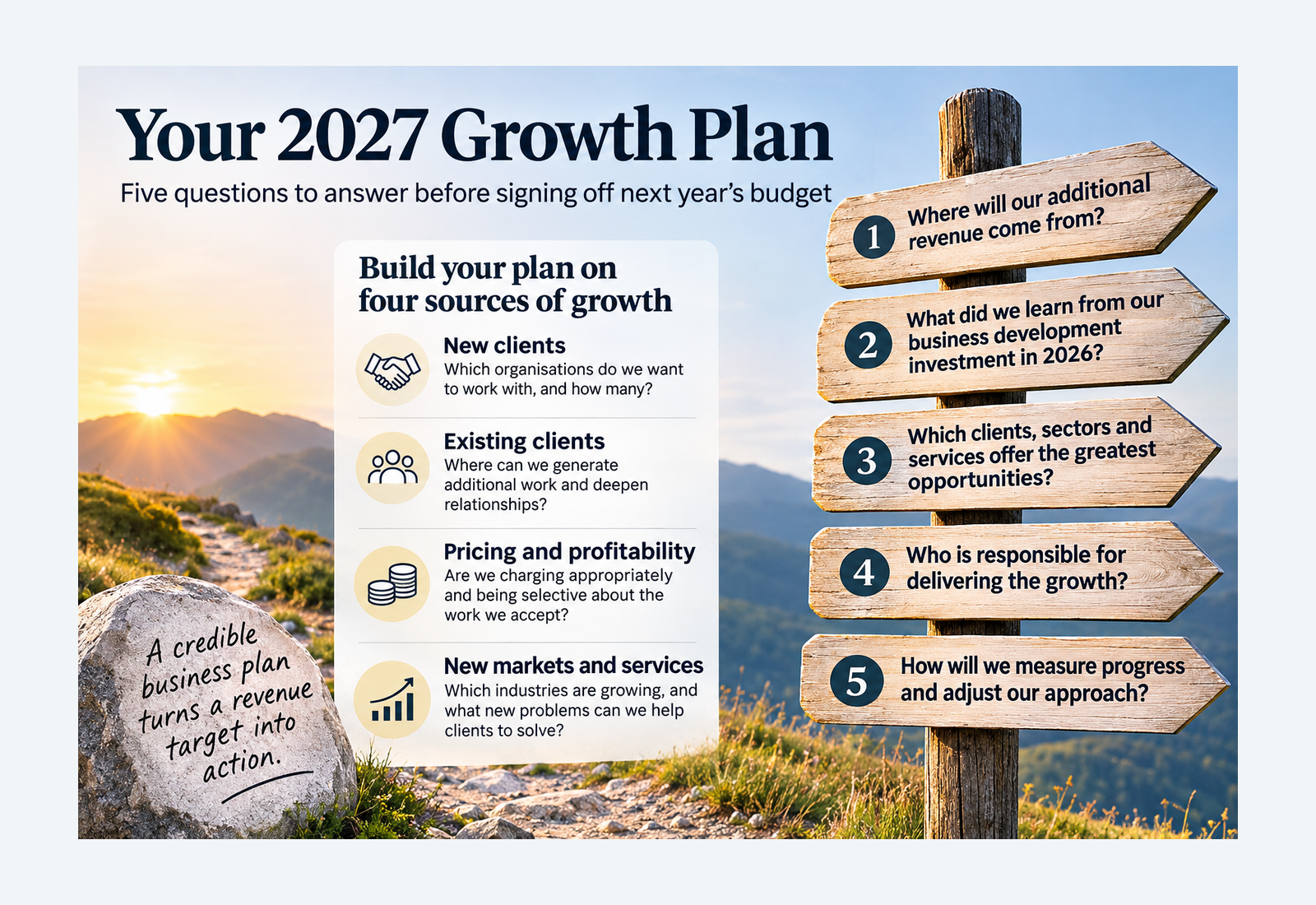
I'd encourage every professional firm to examine four potential sources of additional revenue.
The first is new clients. Which organisations do we want to work with? Who will develop those relationships, and how many new instructions can we realistically expect?
The second is existing clients. This is often the most overlooked opportunity. Where could we generate additional work through client reviews, cross-selling and introducing colleagues with relevant expertise?
Third is pricing and profitability. Are we charging appropriately? Could we improve fee recovery, reduce unnecessary discounting or become more selective about the work we accept? What premium services could we offer?
Finally, consider new markets and services. Which industries are growing? What new problems are our clients facing, and do we have the capabilities to help them?
Once you've identified these opportunities, you can start developing a credible forecast rather than simply an aspiration.
Look backwards before looking forwards
Before approving next year's marketing and business development budget, I'd ask another question. What actually worked in 2026? Marketing leaders face pressure to justify expenditure and demonstrate measurable commercial returns.
How many new clients did we win, and where did they come from? Which events generated meaningful opportunities? Which referral relationships produced instructions? How many proposals did we submit and what percentage converted? I'd also want to understand which existing clients increased their spending and, perhaps most importantly, which activities generated profitable revenue. BONUS QUESTION; How many clients gave us referrals?
Professional firms are often very good at measuring activity. Website visits, newsletter subscribers, event attendance and LinkedIn impressions are all useful indicators. But none automatically translates into new business. I'd rather know that an event generated five qualified opportunities and three new clients than that 150 people attended.
We need to connect marketing expenditure with commercial outcomes. That doesn't mean abandoning activities that build relationships over time. It means understanding why we're investing in them and what we're hoping to achieve.
Build a forecast you can believe
Let's imagine a firm wants to generate an additional £1 million in revenue next year.
Perhaps £400,000 will come from new clients, £300,000 from existing relationships, £200,000 from pricing improvements and £100,000 from a new service. Now we have something to work with.
We can examine the pipeline, historical conversion rates, expected fees and the time required to win and deliver the work. We can also challenge the assumptions behind those numbers. But l'd also caution against judging every activity solely on immediate instructions. Some investments strengthen reputation and relationships over a longer period.
If the firm needs 20 new clients, how many qualified opportunities will it require? If partners expect additional work from existing clients, have they actually identified those opportunities? And does the firm have the capacity to deliver the forecast revenue profitably? How much should you invest to start a relationship with potential new client who matches your ideal client profile?
Hope is not a forecasting methodology.
Give partners responsibility
One of the biggest weaknesses I see in professional services business development is the gap between a firm's ambitions and the behaviour of its people. Everybody agrees that growth is important, but who is actually responsible for making it happen?
I'd encourage every partner to have a simple business development plan identifying their priority clients, target prospects, relationship building activities and expected commercial contribution.
Many firms have an overall marketing plan or have one for individual service lines or sectors, but who exactly is responsible for their attainment? Is it too easy, for too many to let too few do the work?
Not every partner needs to be a rainmaker. Some will excel at attracting new clients, while others are better at developing existing relationships or identifying opportunities for colleagues. But every partner should understand how they contribute to the firm's commercial success. The BD team should support those efforts rather than being expected to generate all the opportunities themselves.
Review progress throughout the year
Finally, don't put the business development plan in a drawer until next November.
Review progress monthly or quarterly. Are opportunities progressing? Are conversion rates improving? Are we winning the right clients? Which activities are delivering results and just as important, what should we stop doing? Markets change, clients change and new opportunities emerge. Your plan needs to evolve accordingly.
Make 2027 different
I've worked with hundreds of professional firms, and one lesson stands out. Growth rarely comes from doing more of everything. It comes from identifying the right opportunities, concentrating resources and holding people accountable for results.
So, before signing off on your 2027 budget, I'd encourage every Managing Partner/CEO/Head of BD to consider five questions.
Where will our additional revenue come from?
What did we learn from our business development investment in 2026?
Which clients, sectors and services offer the greatest opportunities?
Who is responsible for delivering the growth?
How will we measure progress and adjust our approach?
If you can't answer those questions, perhaps the budget needs another look.
Because growth doesn't happen simply because somebody increases next year's revenue target. It happens because people change what they do.
If you need help in making those necessary changes, be sure to reach out.