
Private equity is changing the UK accounting profession. It is no longer something happening on the fringes of the market. ICAEW research found that nearly one third of the mid-tier firms responding to its 2026 survey were now private equity backed. Many had acquired another firm and appetite for further acquisitions remains strong. For the owners of accounting firms, this creates an interesting question. If somebody wanted to buy your firm tomorrow, what exactly would they be buying?
Private Equity in the Accounting Industry
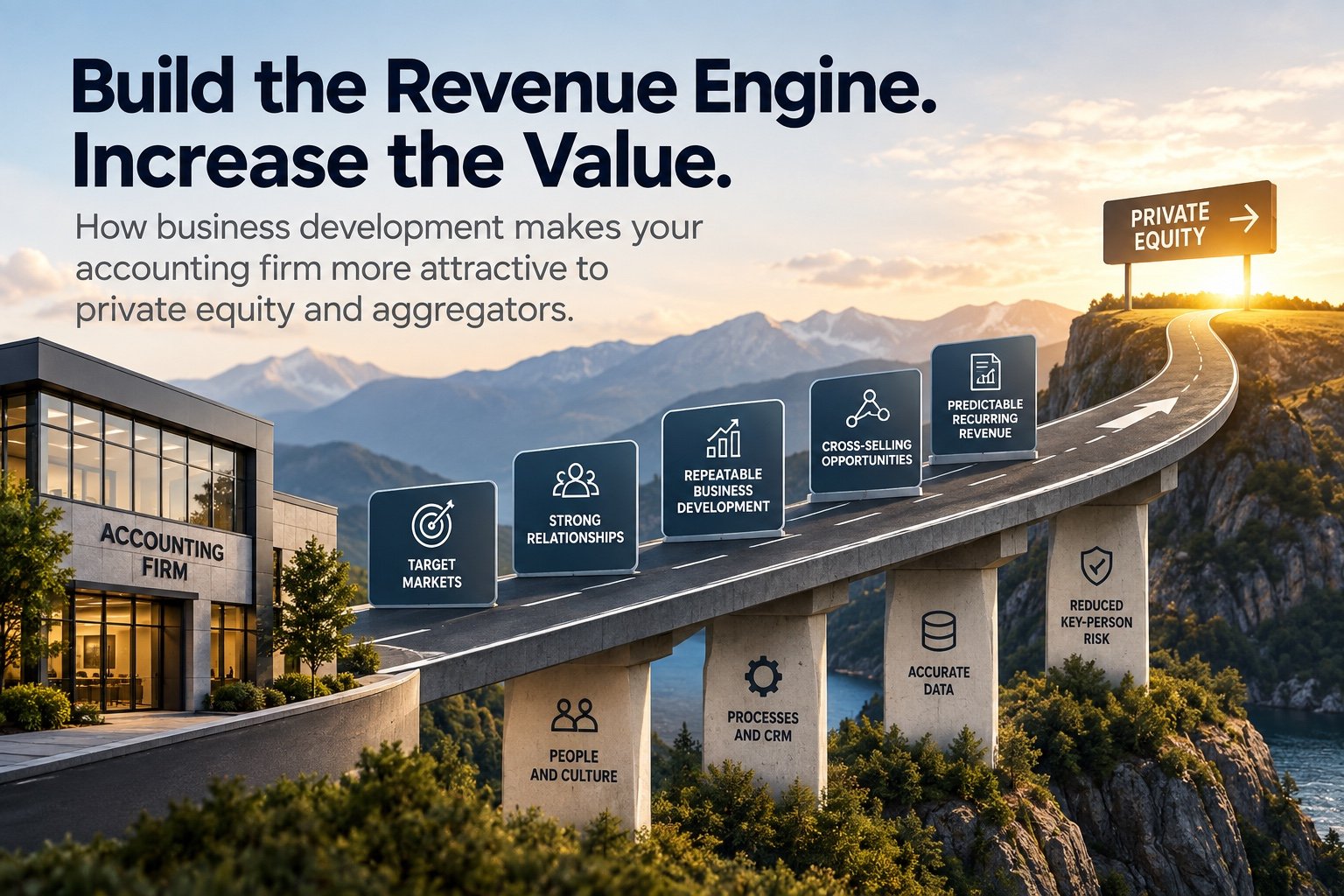
Most partners immediately think about the numbers. Revenue. Profit. EBITDA. Recurring fees. Client retention. All are important when arriving at a multiple. But there is another asset that deserves much more attention than it currently gets: your ability to systematically generate future revenue. That is where business development becomes part of the valuation conversation.
Buyers like predictable revenue
One reason accounting firms have attracted private equity is relatively simple. Much of their revenue happens again next year. Audit. Tax. Payroll. Compliance. Outsourced finance. Research and commentary on the sector consistently identifies recurring revenue as one of the characteristics attracting investors. There is an important distinction here. £10 million of revenue is not necessarily worth the same as another £10 million of revenue. A buyer will want to understand the quality of that revenue.
How much is recurring? How concentrated is it among a handful of clients? How likely are clients to remain? How dependent are those relationships upon individual partners? What opportunities exist to sell additional services? And critically: where will the next £2 million of revenue come from? A firm that can answer that question convincingly is potentially a very different proposition from one relying upon reputation, referrals and the rainmaking ability of two or three senior partners.
Build an engine, not a collection of rainmakers
Many professional services firms don't really have a business development system. They have people who are good at business development. There is a big difference. Take three rainmaking partners out of some firms and new business would slow dramatically. That represents risk. Investors don’t like risk.
The alternative is to create a repeatable business development engine. One where target clients have been identified, sectors have been prioritised and partners know which clients and prospects they are responsible for developing. Referral relationships are actively managed. Opportunities are recorded. Pipelines are reviewed. Conversion rates are measured. Cross-selling happens systematically. People below partner level are learning how to develop business.
Now imagine looking at two firms as a potential investor. One says: "We have some excellent partners who are very well connected." The other says: "Here is our pipeline. Here are our conversion rates. Here are our top referral channels. Here is our client retention. Here is the revenue generated through cross-selling. Here are the people responsible for delivering next year's growth. AND, here are our routes to market beyond referrals and AdWords.” Which business is easier to understand? More importantly, which future revenue stream appears easier to predict?
The founder-dependency problem
There is another uncomfortable question accounting firms should ask. What happens if the managing partner leaves? Or the founder retires? Or the partner responsible for 20% of the client base walks out of the door? A firm heavily dependent upon individual relationships carries a different risk profile from one where relationships are institutionalised.
That means introducing multiple people to important clients, holding regular client review meetings and documenting client knowledge properly. It also means developing the next generation of relationship owners and making the firm's relationship with the client broader than the relationship between two individuals. This is good business development practice anyway. But viewed through an investment lens, it does something else. It reduces key-person risk.
Cross-selling suddenly becomes much more interesting
There is often a substantial gap between what professional services firms could sell existing clients and what they actually sell them. I have seen this repeatedly. The tax partner doesn't spot an opportunity for corporate finance. The payroll team doesn't identify an opportunity for business advisory. One office barely knows the clients of another. Everybody talks about cross-selling. Far fewer firms have built a process for making it happen. Private equity investors see the opportunity. One attraction of consolidation is the ability to bring businesses together and sell a wider range of services across an enlarged client base. But why wait for an investor to unlock that value?
Accounting firms can start building it themselves. Measure how many services your top 100 clients currently buy. Identify the gaps. Create structured client review and feedback programmes. Teach partners how to identify opportunities for colleagues. Measure introductions between service lines. Then measure the revenue those introductions create. Suddenly cross-selling stops being an aspiration. It becomes part of the firm's commercial infrastructure.
Your BD data matters too
We often talk about getting financial data ready before a transaction. The same principle should apply to business development data. Could you tell a prospective investor where your new clients came from last year? Which sectors are growing fastest? Your proposal to instruction conversion rate? Your top 10 referral sources? Your client retention rate? Could you show them the revenue generated from cross selling? The value of your current qualified pipeline? Which partners generate new work consistently? Which clients have significant untapped potential?
If the answer is no, you have another opportunity to improve the business. A functioning CRM isn't simply a marketing tool. Used properly, it becomes evidence of how the firm's growth engine works.
Don't wait until you want to sell
This may be the most important point. You don't need to have any intention of selling your accounting firm to start thinking this way. Building predictable recurring revenue is sensible. Reducing dependence upon individual partners is sensible. Improving client retention is sensible. Creating a measurable pipeline is sensible. Developing cross-selling is sensible. Training the next generation of rainmakers is sensible. Knowing exactly where new business comes from is sensible. These things potentially make a firm more attractive to an investor. But they also make it a better business to own and work in.
That is why I think accounting firm leaders should start looking at business development differently. It isn't simply about generating more leads. And it certainly isn't about telling partners to attend more networking events. It is about building an asset: a repeatable, measurable and transferable revenue engine.
Because when somebody eventually asks what your accounting firm is worth, the most interesting question might not be: "What did you turnover last year?" It might be: "Show me how you are going to win next year's revenue."
If you need ideas, I can share my learning from working with more than 250+ professional firms. As I've seen the same growth problems repeatedly, I can identify patterns that may be difficult to see from inside just one firm.